
Guilford during the American Revolution

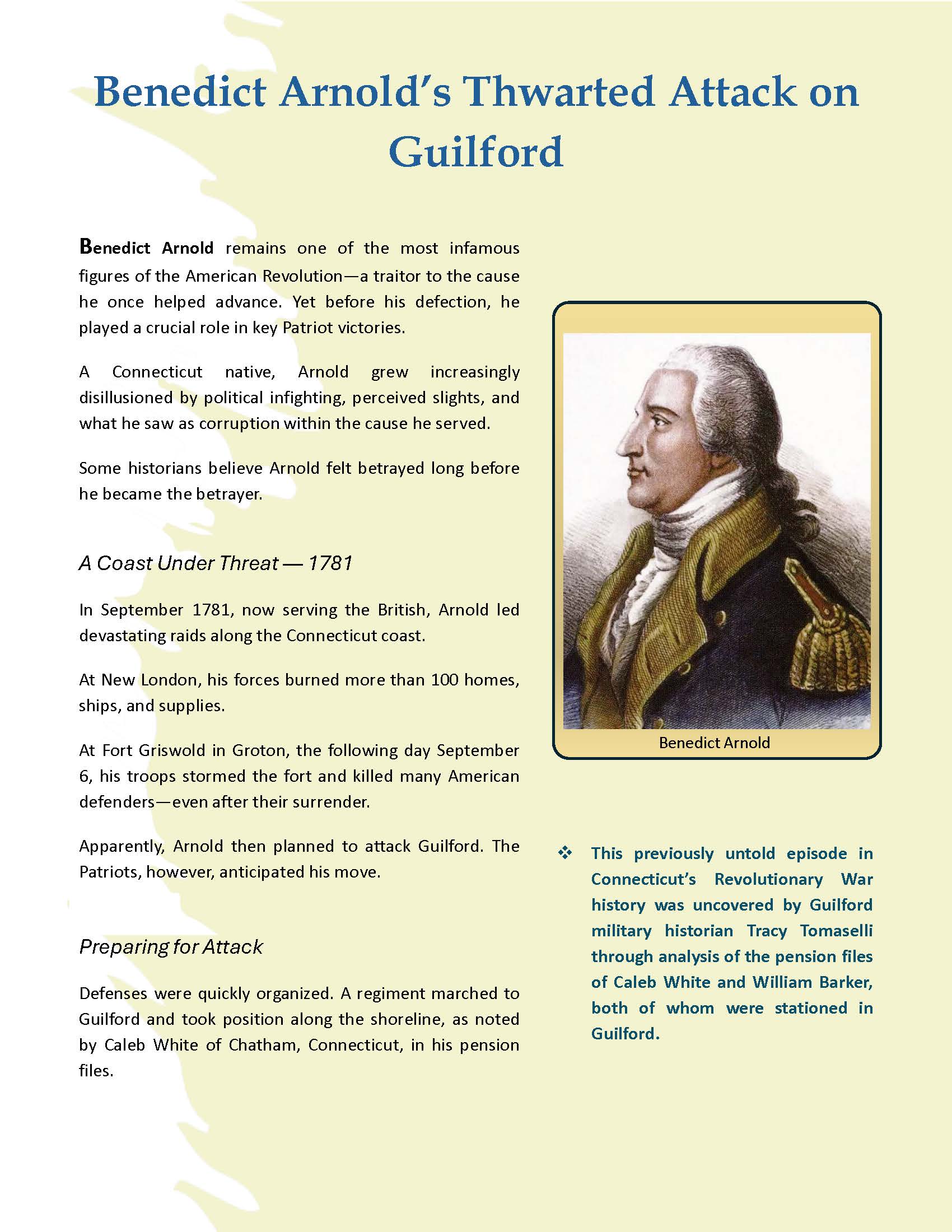
Benedict Arnold remains one of the most infamous figures of the American Revolution—a traitor to the cause he once helped advance. Yet before his defection, he played a crucial role in key Patriot victories.
A Connecticut native, Arnold grew increasingly disillusioned by political infighting, perceived slights, and what he saw as corruption within the cause he served.
Some historians believe Arnold felt betrayed long before he became the betrayer.
In September 1781, now serving the British, Arnold led devastating raids along the Connecticut coast.
At New London, his forces burned more than 100 homes, ships, and supplies.
At Fort Griswold in Groton, the following day September 6, his troops stormed the fort and killed many American defenders—even after their surrender.
Apparently, Arnold then planned to attack Guilford. The Patriots, however, anticipated his move.
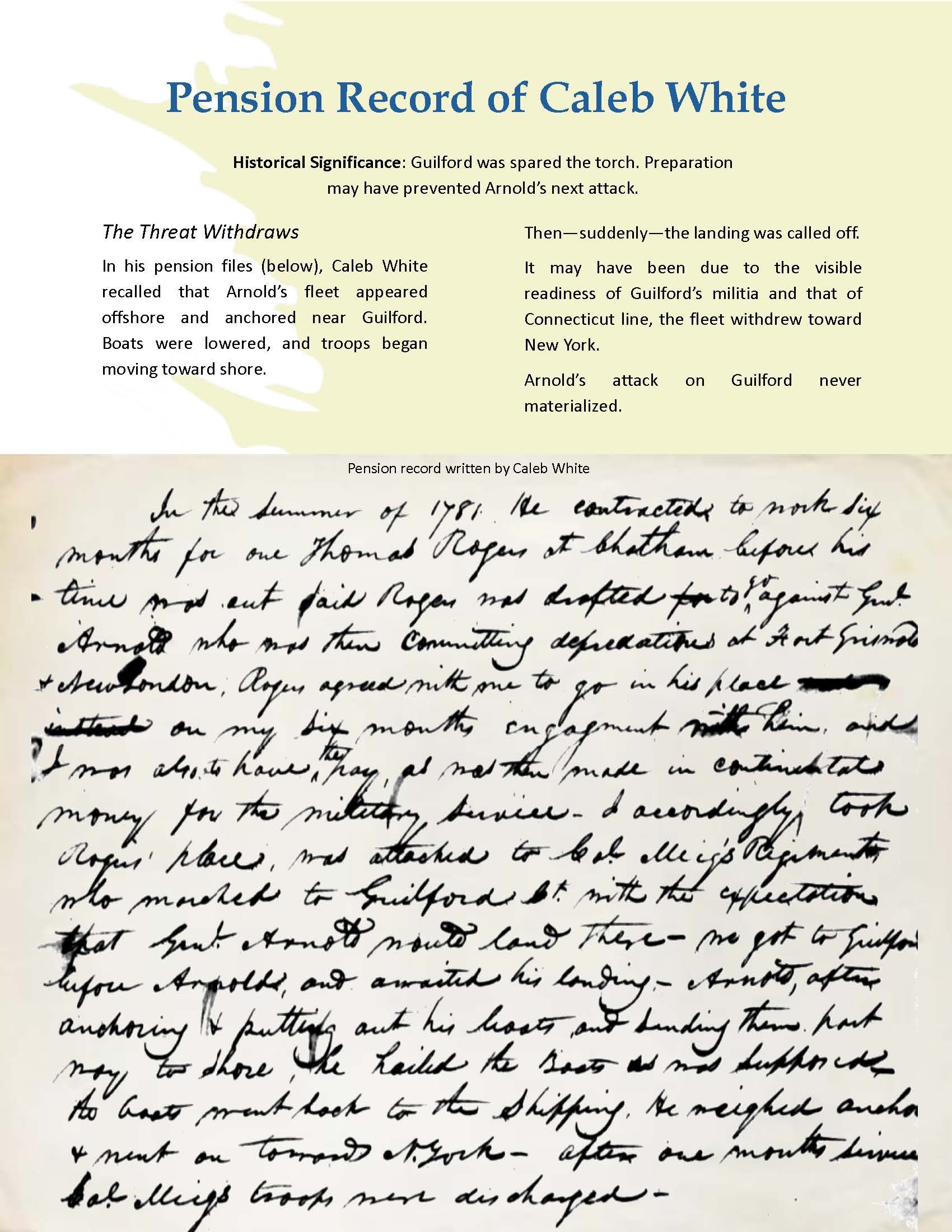
Defenses were quickly organized. A regiment marched to Guilford and took position along the shoreline, as noted by Caleb White of Chatham, Connecticut, in his pension files.
“marched to Guilford Ct. with the expectation that Genl. Arnold would land there — we got to Guilford before Arnold, and awaited his landing — Arnold, after anchoring & putting out his boats and sending them part way to shore, he hailed the boats and was supported as boats went back to the shipping. He weighed anchor & went on towards New York”
The defenses at Guilford had thwarted Arnold’s attempt to attack. The guards, after one months service were discharged.
This previously untold episode in Connecticut’s Revolutionary War history was found by Tracy Tomaselli, Historical Room Specialist, Guilford Free Library, in the pension files of Caleb White and William Barker, who were stationed in Guilford. Slide by John Plant, GKS.
Louise K. Platt was born on 3 Aug 1915, in Stamford, CT, and later resided at Elm Street, North Guilford, CT, with her sister, Jean, and their mother, Mrs. Edna Platt.
Louise was an actress who began her career in summer stock production theatre in 1936. In 1938, she landed a part as Brenda Wayne in the movie I Met My Love Again, starring Joan Bennett and Henry Fonda. Louise performed in several productions at the Chapel Playhouse in Guilford during the summer of 1939. Her “career from bit parts to stardom in Hollywood was followed with pride by Guilford people.” She is best remembered for her role as Mrs. Lucy Mallory in the movie Stagecoach (1939) and performed with actors including John Wayne, Rex Harrison, and Melvyn Douglas. She also performed on Broadway and as Ruth Holden in the soap opera The Guiding Light.
Louise married her second husband, director Stanley Gould at the North Guilford Congregational Church, North Guilford, CT, on 25 Aug 1950. They remained together until his death in 1990. She had two daughters, one from each marriage. Louise died on 6 Sep 2003 at a hospital in Greenport, NY, at the age of 88.

Compiled by Tracy Thompson Tomaselli (2024)
Notes/Sources:
The Chapel Playhouse (1933-1951) was located at 49 Park Street and is currently the First Church of Christ, Scientist. Her sister, Jean, also performed there.
Shore Line Times 16 Feb 1939:1; 13 Mar 1941:7, GVR:1950:51
https://waytofamous.com/20327-louise-platt.html
Letter From the President.
The mission of GPA is to preserve the built and natural environment of our beautiful town.
I would like to share with you some of our latest newsletter.
Guilford Preservation Alliance_Newsletter_Nov 2022-1
Would Guilford have been founded by Henry Whitfield if he married Margaret Hardware, his first finance?
Upon graduation from Oxford, Henry Whitfield began the study of law. Circa 1615/1616, Henry Whitfield was engaged to marry Margaret Hardware, the daughter of Henry Hardware. In February 1616, before the marriage took place, Margaret Hardware died. In her will, probated 17 Mar 1616, she bequeathed to Henry Whitfield, “my loving friend and contracted husband, the sum of one hundred and forty pounds, one white ‘beare’ bowl, one Tune (vessel or jar) and cover and three spoons, one piece of gold of three pounds seventeen shillings, one pair of Valence and two cushings of needle work; four towels, two short and two long; three pair of sheets of flaxen of the best; four pillow-beares; one dozen of fringed napkins, four of the best table-cloths; two cupboard cloths; one feather bed, two bolsters, two down pillows, one arras coverlet, four blankets, and all the apparel that was provided for my marriage…Memorandum, that if, after all my debts and legacies are paid, the remainder of my estate be above fifty pounds, that then Mr. Nicholas Byfield have only that fifty pounds, and my loving friend and contracted husband, Mr. Henry Whitfeild, have the rest of my whole estate.”
If Margaret Hardware had not died and their marriage took place, Henry may have continued practicing law. If so, Guilford may not have been founded by him, and the stone house may never have been built for him.
Shortly after the death of Margaret Hardware, Henry Whitfield changed from law to ministry. In 1618, he was ordained a minister of the Church of England. That same year he married Dorothy Sheaffe, a daughter of Thomas Sheaffe, who was a Kentish clergyman. Whitfield became a vicar of St. Margaret’s Church in Ockley, Surrey, England.
During the reign of Charles I, in the early seventeenth century, the Church of England began its persecution of dissidents within the church. Separatists and Puritans alike were censured, and some had to flee England. In 1638, Henry Whitfield, age forty-six at that time, resigned his position as head of the Ockley church. He gathered around him about two dozen families from Surrey and Kent and a few further north in England to emigrate.
The sad untimely death of young Margaret Hardware could have altered the history of Guilford if it had not occurred, and, as a result, many of the descendants of Henry Whitfield and other founding fathers may never have been born.
Compiled by Tracy Thompson Tomaselli (24 Jun 2023)
Ship images inside historic Guilford homes
There are several images of ships appearing on the walls of several historic Guilford homes. Some of these homes were owned by those having ties to some type of maritime enterprise or history, and some of these homes were owned by those who were slave owners.
In the attic at 65 Water Street, is a chalk drawing of a ship. That house was originally located on the corner of Whitfield & Boston Streets and moved to 65 Water Street in 1958. That house was built in 1763 for Elias Cadwell, Jr. who was a slave owner, and it is possible that one of his slaves drew that image.
Another house where two ship images were etched into the wood walls leading to the attic is located at 85 Boston Street. This house, known as the Thomas Burgis II house, was built c. 1735/36. Currently, there is no known record that Thomas Burgis II was a slave owner. However, his father, Thomas Burgis was a native of Yorkshire, England, and was compelled to serve for several years aboard a British man-o-war.
It is also possible that the ship graffiti was done by a later owner or occupant.
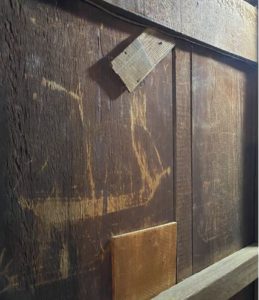
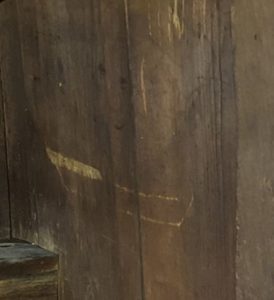
85 Boston Street – Ship 1 (etched) 85 Boston Street – Ship 2 (etched)
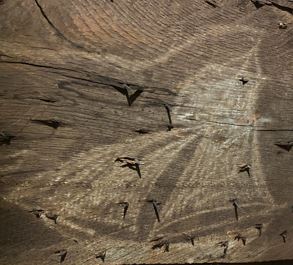
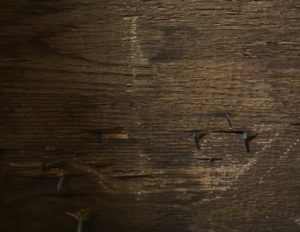
65 Water Street – Ship 1 (chalk) 65 Water Street – Ship 2 (etched)
Photos taken by Tracy Tomaselli (October 2021)