


Guilford during the American Revolution

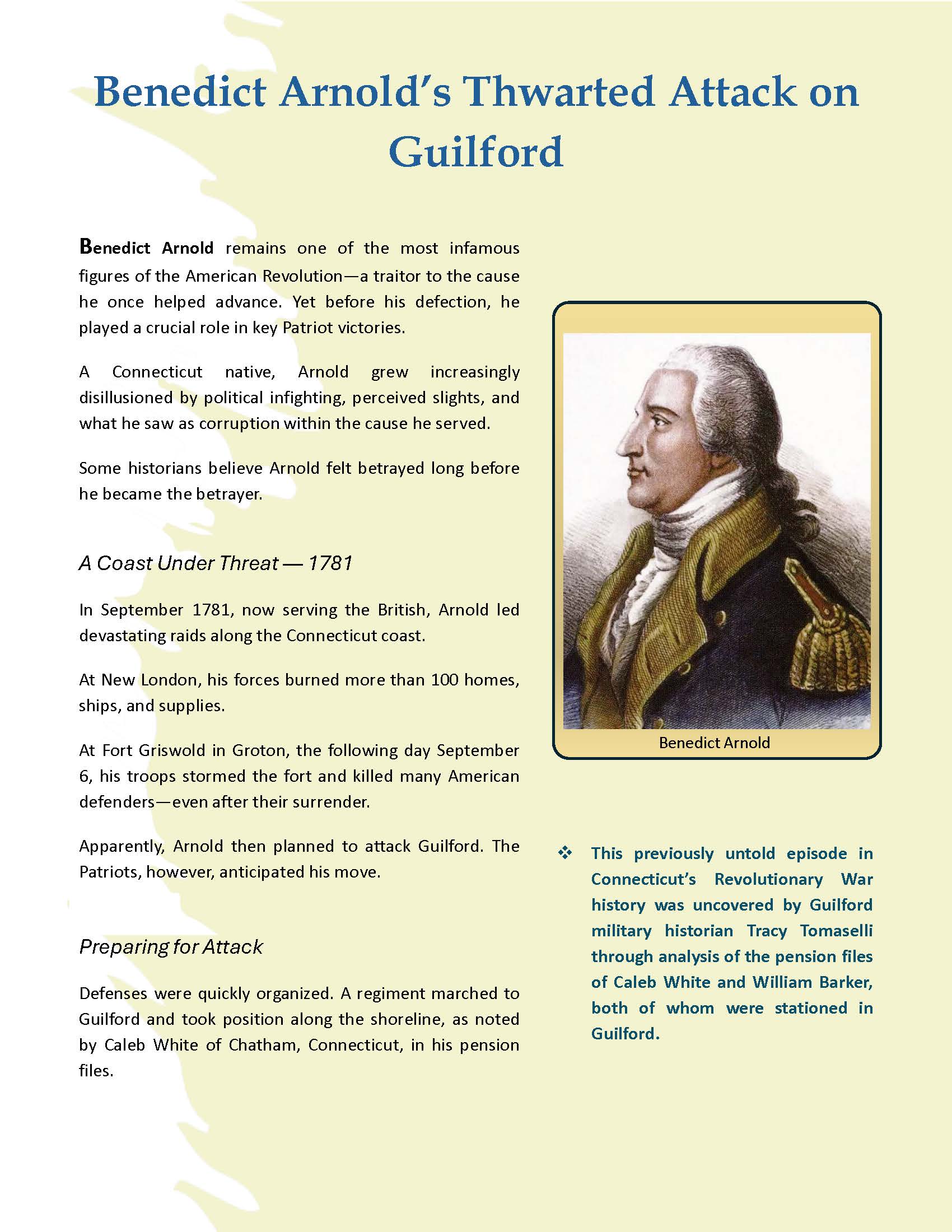
Benedict Arnold remains one of the most infamous figures of the American Revolution—a traitor to the cause he once helped advance. Yet before his defection, he played a crucial role in key Patriot victories.
A Connecticut native, Arnold grew increasingly disillusioned by political infighting, perceived slights, and what he saw as corruption within the cause he served.
Some historians believe Arnold felt betrayed long before he became the betrayer.
In September 1781, now serving the British, Arnold led devastating raids along the Connecticut coast.
At New London, his forces burned more than 100 homes, ships, and supplies.
At Fort Griswold in Groton, the following day September 6, his troops stormed the fort and killed many American defenders—even after their surrender.
Apparently, Arnold then planned to attack Guilford. The Patriots, however, anticipated his move.
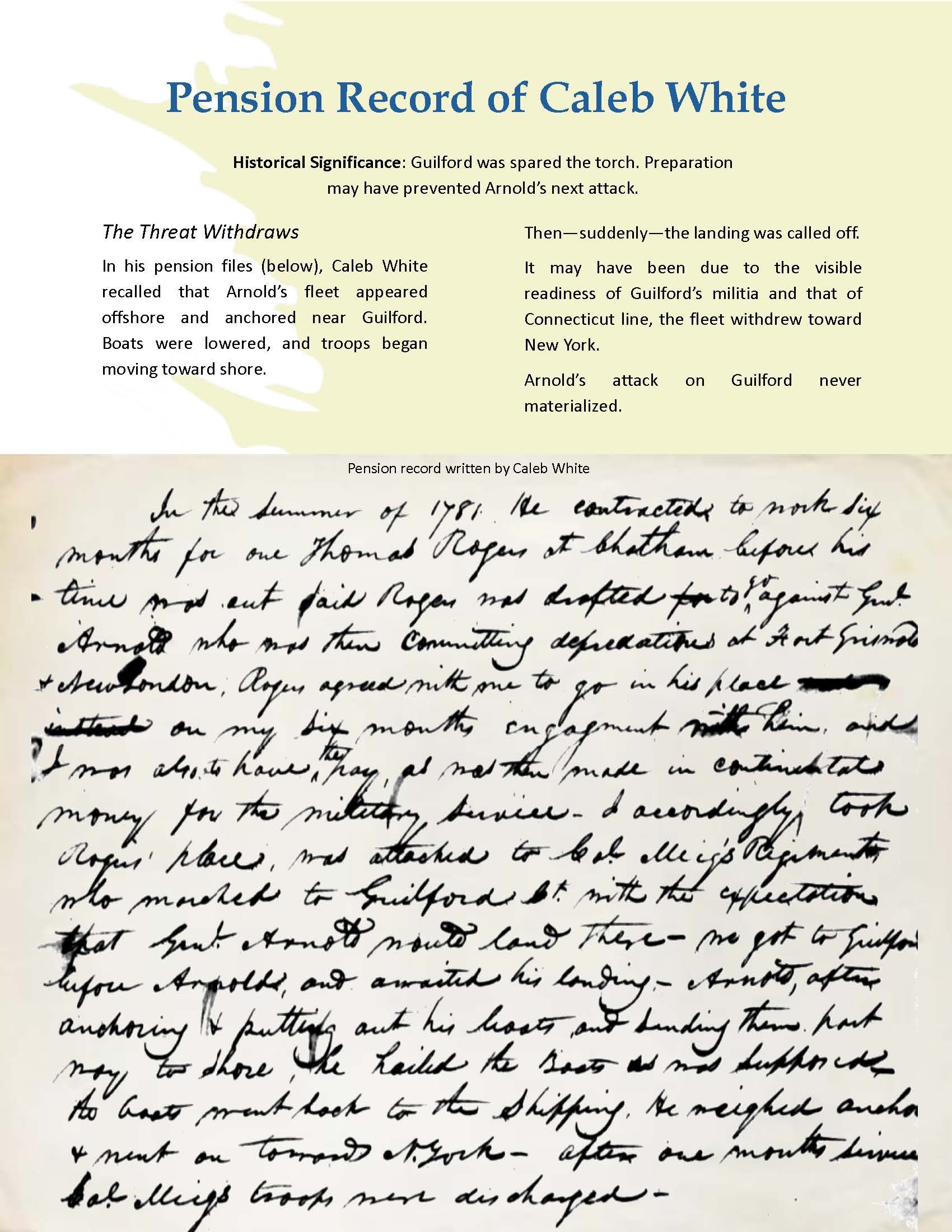
Defenses were quickly organized. A regiment marched to Guilford and took position along the shoreline, as noted by Caleb White of Chatham, Connecticut, in his pension files.
“marched to Guilford Ct. with the expectation that Genl. Arnold would land there — we got to Guilford before Arnold, and awaited his landing — Arnold, after anchoring & putting out his boats and sending them part way to shore, he hailed the boats and was supported as boats went back to the shipping. He weighed anchor & went on towards New York”
The defenses at Guilford had thwarted Arnold’s attempt to attack. The guards, after one months service were discharged.
This previously untold episode in Connecticut’s Revolutionary War history was found by Tracy Tomaselli, Historical Room Specialist, Guilford Free Library, in the pension files of Caleb White and William Barker, who were stationed in Guilford. Slide by John Plant, GKS.
Ship images inside historic Guilford homes
There are several images of ships appearing on the walls of several historic Guilford homes. Some of these homes were owned by those having ties to some type of maritime enterprise or history, and some of these homes were owned by those who were slave owners.
In the attic at 65 Water Street, is a chalk drawing of a ship. That house was originally located on the corner of Whitfield & Boston Streets and moved to 65 Water Street in 1958. That house was built in 1763 for Elias Cadwell, Jr. who was a slave owner, and it is possible that one of his slaves drew that image.
Another house where two ship images were etched into the wood walls leading to the attic is located at 85 Boston Street. This house, known as the Thomas Burgis II house, was built c. 1735/36. Currently, there is no known record that Thomas Burgis II was a slave owner. However, his father, Thomas Burgis was a native of Yorkshire, England, and was compelled to serve for several years aboard a British man-o-war.
It is also possible that the ship graffiti was done by a later owner or occupant.
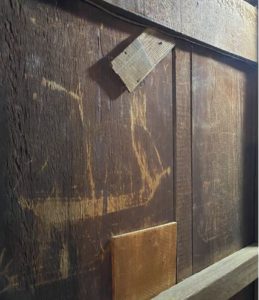
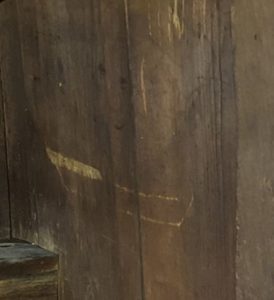
85 Boston Street – Ship 1 (etched) 85 Boston Street – Ship 2 (etched)
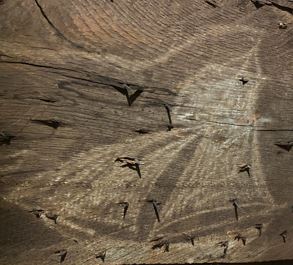
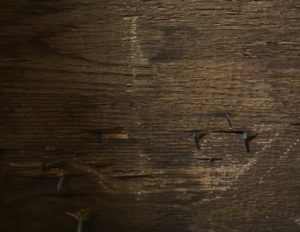
65 Water Street – Ship 1 (chalk) 65 Water Street – Ship 2 (etched)
Photos taken by Tracy Tomaselli (October 2021)
At a General Court, held at Guilford, June 28, 1652, it was “voted, the matter about a College at New Haven for us of this jurisdiction to undergo alone; especially considering the unsettled state of New Haven Town; being publicly declared…to be a place of no comfortable subsistence for the present inhabitants there. But if Connecticut do join, the planters are generally willing to bear their just proportions for erecting and maintaining a College there”.
In October 1701, the Legislature, granted a charter, constituting “Trustees of a Collegiate School in his Majesty’s Colony of Connecticut; and invested them with all the powers which were supposed to be necessary for the complete execution of their trust. The following November, they chose one of their number, Mr. Pierson, rector of the school, and determined that it should be fixed for the present at Saybrook”.
“In the year 1702, the first commencement was held at Saybrook, at which five young gentlemen received the degree of A. M. From this time many debates arose concerning the place where the school should finally be established and continued to agitate the community.” October 17, 1716, with the community still disunited, four of the nine trustees strongly voted against moving the school to New Haven. “The trustees, nerveless, proceeded to hold the commencement, the following year, at New Haven, and to order a college to be erected. It was accordingly raised in October 1717 and finished the following year.” The building, enabled through a number of considerable donations, “was built of wood, one hundred and seventy feet long, twenty-two feet wide, and cost about £1000 sterling. Before it was erected, the students were scattered in various places, as Milford, Killingworth, Guilford, Saybrook, Wethersfield, &c. Soon afterwards, they all removed to New Haven. The number of the students was about 40, the course of education was pursued with spirit, the benefactions increased in number and value, from this time the institution began to flourish.”
Connecticut Historical Collections, History and Antiquities of Every Town in Connecticut. John Warner Barber 1836 p. 146
The front page of the Shore Line Times on April 21, 1910, included an article regarding the 1910 census, which at that time was in progress.
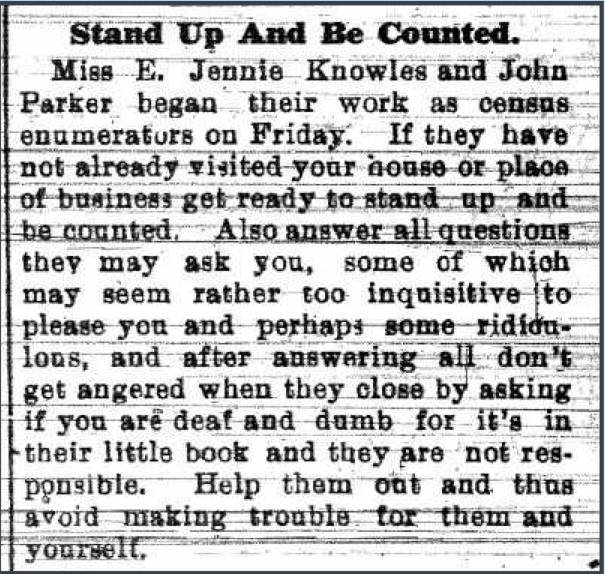 Each time the census has been taken it has included different questions to collect data for different reasons. [Read more…]
The ship named the Favorite, owned by Robert Johnston & Co, James Brown, and Richard and Abraham S. Hallett, and John G. Warren, all of New York, departed in 1800 with cargo owned by Frederic de Peyster and John Slidell. Bound for Cape Francis, the ship, commanded by Captain Charles Barnard, was captured on October 4, 1800, in lat. 20, long. 66, by the French privateer schooner the Patriot, and ordered to St. Pierre, Guadeloupe.
On December 4, 1800, a young man wrote a letter to his father in Guilford. The young man, who was in St. Kitts at the time, wrote “Honored Father – I embrace this opportunity to convey you a line, and inform you of my situation. I sailed from New York about the 12th of October, in the ship Favorite, Capt. Barnard, bound to Cape Francois. On the 4th of Nov. was taken by a French privateer, and carried into Guadaloupe, put into prison, and have just arrived here in a cartel. They took from me everything I had, both my venture and clothing, and scarcely left me a shirt to my back. Here I am destitute of a ship, money, or friends, and a stranger in a foreign land. Here are several vessels from northern ports, and one from New Haven, none of them will give me a passage. I am now bound to St. Bartholomew’s, in hopes that I shall get a vessel there bound to some part of America.”
Captain Barnard, of the ship the Favorite, in the previous year, had his sloop, the Cornelia, captured by the French, who condemned the vessel and cargo and sold that sloop at Guadeloupe.
The identity of the young man who wrote the letter to his father on December 4, 1800, is unknown.
Sources:
Mercantile Advertiser 22 Aug 1800 p3
Daily Advertiser 23 Dec 1800 p3
Litchfield Monitor 4 Feb 1801 p3
Federal Gazette & Baltimore Daily Advertiser 22 Jan 1800 p3
The French assault on American shipping, 1793-1813 : a history and comprehensive record of merchant marine losses. Greg H. Williams 2009
Compiled by Tracy Tomaselli 2020
In June 1917, a new fire alarm system was installed at Norton’s garage, 78 Boston Street, and connected with the local telephone exchange. When a fire broke out, callers were to notify the Central Telephone office on Whitfield Street, and the operator was to “pull” the alarm.
The borough officials arranged a system of signals for use when the fire whistle was put in commission to inform people of the location of the fire. The apparatus required seventy pounds of compressed air, to blow a signal three times, and was to be powerful and loud enough to be heard all over the borough in any kind of weather condition. [Read more…]
Whist is a classic English trick-taking card game which was widely played in the 18th and 19th centuries. The game takes its name from the 17th Century whist (or wist) meaning quiet, silent or attentive.
The classic game of whist is a plain-trick game without bidding for 4 players in fixed partnerships. A standard 52 deck of cards is used. The cards in each suit rank from highest to lowest.
Each player is dealt 13 cards, the trump suit for each trick (or round) is indicated by the last card dealt (to the dealer). [Read more…]
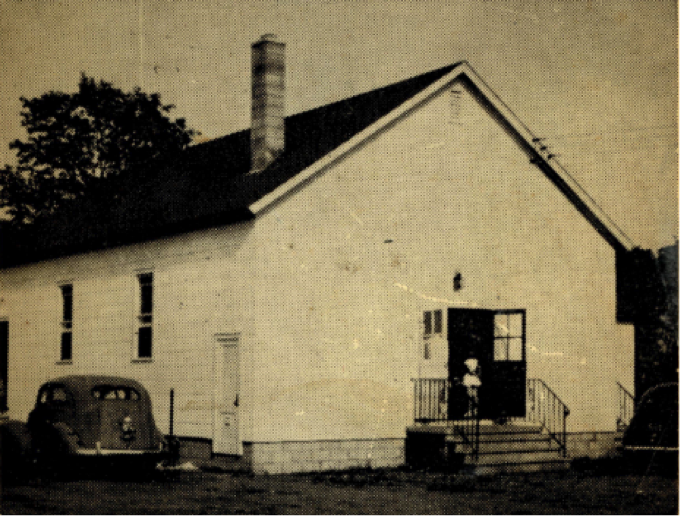 The Ladies Auxiliary, Guilford Grange No. 81, assembled a “Favorite Recipes” book in 1955. The book, “dedicated to the Modern Home”, where “Life is centered around our kitchens”, included “treasured old family recipes.”
An article in 1821 mentioned that a few had aided in missionary work “for the Heathen”, but encouraged more participation. [1]
Later that year, donations of clothing, bedding, goods and cash, were collected for the Elliot Mission. The Elliott mission attempted to bring the Indians of the Choctaw nation to salvation through making the Indians use the English language, civilizing their habits, and making them Christian in their religion. [2] [3] [4]
In 1823, the Ladies’ Society in North Guilford raised $332 and a couple articles of clothing for the Foreign Mission School in Cornwall. [Read more…]