
Guilford Preservation Alliance

Witness to History Slavery in Guilford

Donate to the Guilford Preservation Alliance

  • Home
  • About Us
    • Mission Statement
    • By-Laws
    • Jones Trust Fund
    • Board & Officers
    • Awards
    • FAQs about GPA
  • GPA Projects
    • Guilford Train Station
    • Trolley program “Back on Track”
    • Town Center South
    • Guilford Village Walkways
    • Stone Walls
    • Barn Survey
    • Faulkner’s Light Brigade
    • Newsletter Archives
    • Summary of GPA Accomplishments
    • Kiosk Opening
    • Recreational Areas Map
  • Guilford Bookshelf
  • Historic Guilford
    • Historic Walking Tours
    • A Resource Guide to Historic Homes
    • National Register of Historic Places
    • Local Historic Districts
    • Heritage Tourism Initiative
    • Master Plan of Guilford
    • FAQs about Guilford
    • Demolition-Delay Ordinance
  • Guilford: A Walking Guide
  • Illustrated Historic Survey
  • Archives/News
  • Become a Member
  • Contact Us
  • Historical Plaques
    • Monroe Building
    • Sarah and Robert Shelley House
    • First National Store
    • Dan Collins House
    • Major Jedediah Lathrop House
    • Dr. Jared Redfield House
    • James Monroe Store
You are here: Home / Archives for Web Editor

May 6, 2011 By Web Editor

What’s new, what’s old

A column by Howard Brown, widely acclaimed environmental and management consultant and GPA board member.

Preservation and Change.

I often hear people say that nothing ever changes around here.  When I moved to Guilford in 1970, there was one traffic light.  Route 1 was a rural road through open fields and woods.   Most of the houses along the shoreline were uninsulated summer cottages.  The population was about 8,000 and an acre of land was about $8000. Many of the houses in the center of town were in need of repair.

We often forget how many of the  things we take for granted in our daily lives are actually new.  The Connecticut Turnpike (now I-95) was only completed in 1958.  Before that auto access to this town was all via Route 1, which more resembled Rt. 146 than its present incarnation with shoulders and modern lanes. Even into the 1950’s, many houses in town still didn’t have decent plumbing.  For the residents of what is now the Griswold House, electricity was a single light bulb hanging from the ceiling.

Perhaps, most significantly, when I moved to the town in 1970, there was still very little public interest in municipal government and very little citizen involvement in town affairs.  From an economic point of view, in 1970, Guilford was largely rural, just on the verge of a growth spurt that would change its character.

For all of the change and new prosperity, Guilford has managed to avoid many of the negative affects that befell towns along the I-95 corridor.  Active citizenry helped channel development in relatively constructive ways, and that helped preserve and protect many of the community’s assets.   Now, as the national economy has begun to slowly recover from a deep recession, and as development pressure spreads east from New York along I-95, the people of Guilford need to make new choices about what kind of town we want to live in, and how to channel the powerful economic forces of development in constructive ways to achieve our goals.

Local Economies and Responsible Development

Preservation and economic development are actually two sides of the same coin.  In fact, historic and environmental preservalition are often key drivers of a healthy local economy.  The term sustainable development, which has increasingly become a goal of communities across the country, is often defined as meeting the needs of the today’s citizens without compromising future generations’ capacity to meet their needs.  This is an underlying principle of GPA’s work.

Effective economic development is about enhancing the the economic and social wellbeing of the people in a community by building an economy that is robust and can stay healthy even during booms and busts of larger economic cycles.   Economists who study local economies look for many indicators of health and success.  They tend to look beyond the common assumptions about commercial real estate development to understand what makes some communities thrive while others struggle with cycles of rising costs, rising taxes, declining municipal services and declining property values.  One thing is clear, the towns that are the most attractive places to visit and live are neither hostile to development nor indifferent to their uniqueness.   The communities that most people consider desirable are the ones with the wisdom to embrace yet channel development to enhance their uniqueness.

More than half of Guilford’s households have settled here since 1970.  Most moved here from other places because the unique rural and historic village character of the town is still intact.  GPA  believes that the healthiest economic development should stem from policies and programs that build on the strengths that make Guilford a special and desirable place, rather than activities that make it more like every other place.

Guilford’s historic architecture and landscapes, its charming town center, its quintessential New England coastline, its farms and rolling hills in the north, and its extraordinary ecological diversity, are all features that contribute to its uniqueness.   Though Guilford is geographically one of the largest towns in CT, nearly 18 of its 50 square miles are now protected open space with a growing network of nature trails and resources.   It also has a blend of small retail shops, growing small businesses, and a burgeoning regional medical services and technology sector.  We are the only town in Connecticut with two important highways (146 and 77) designated by the State as Scenic Roads.  All of these assets represent important opportunities to encourage low impact tourism, and expand the health- and medical-related business environment.

Over the years, the GPA has helped preserve our architectural heritage—by securing national and regional recognition for it—and has worked to support open space preservation and protect small farms and local businesses.  In the coming year, we will be using this site to share more information about our economic development initiatives, and we look forward to hearing your thoughts and ideas.

Howard Brown
GPA Board member

Share

Filed Under: Archive of Posts, Sustainable Guilford Tagged With: Historic Guilford, Sustainable development

May 6, 2011 By Web Editor

Trolley Days

The unpretentious utilitarian building at the corner of Water and River Streets evokes memories of the time when Guilford residents could hop aboard an electric trolley on the Green and take the scenic route up and down the shoreline, from New Haven to New London and beyond.

Presently occupied by a carpet store, the old trolley barn was built around 1910 and served as a maintenance facility for electric railway cars until 1930. During the brief heyday of the interurban trolley, before the muffled roar of highway traffic disturbed the peace, the gentle ding-ding-ding of the trolley bell signaled a vital link between small agricultural communities like Guilford and the wider world.

We hope that you and your families will join us for our free spring program on May 10, when we’ll turn back the clock and recapture the magic of Guilford’s bygone trolley era. There will be old-time music, displays, slide shows, refreshments, and a presentation by a founding member of East Haven’s renowned Trolley Museum.  The doors will open at 6:30, and we promise to get you home at an early hour (see the page on our website about our program, “Back on Track” for more information).

Although we can’t bring back the electric trolleys, the issues of mass transit and energy-efficient “transit-oriented” development are very much on the agenda of both the GPA and town officials these days. Guilford is fortunate to have excellent commuter rail service seven days a week, as well as hourly bus service to and from New Haven on weekdays. Experience has shown that mass transit isn’t a luxury that only big-city residents can enjoy. It’s an essential part of the infrastructure that sustains the local economies of small and middle-sized towns like Guilford.

Elsewhere on our website, my fellow bloggers Howard Brown and Dennis Culliton shed light on two of the GPA’s longstanding priorities—sustainable development and historic preservation. Far from being mutually exclusive, it’s our belief that, as Howard says, “preservation and economic development are two sides of the same coin.” For example, the GPA’s ongoing efforts to preserve Guilford‘s 19th-century railroad station buildings are fueled by a conviction that such historic resources can be a driving force in the economic revitalization of our town center.

Through our website, public programs, and other activities, the GPA will continue to keep you informed about news and events of interest to our community. Guilfordpreservation.org is a work in progress. Among the enhancements you can look forward to is a greatly expanded and more user-friendly online registry of historic buildings around town. Stay tuned, visit us often, and please let us hear from you.

Best wishes,

Harry Haskell
President

Share

Filed Under: Archive of Posts, View from the Chair Tagged With: Trolleys

April 18, 2011 By Web Editor

Spring Program

We had a great turnout for our spring program “Back on Track,” celebrating trolley days from New Haven to Guilford, and Stony Creek to Ivoryton. We’ll be posting some of the historical photos and other displays here on our website. At the spring program we gave out 2 Awards of Merit for 2011–you can read about them on our Awards Page.

Share

Filed Under: Archive of Posts, What's New Tagged With: Trolleys

February 17, 2011 By Web Editor

Railroad photos

The Guilford Preservation Alliance is looking for photos of the railroad in Guilford (including the old station buildings, people associated with the buildings, locomotives, etc.) from after 1900, particularly the World War II era. The photos could be used as part of a permanent historical exhibit to be installed in the Shoreline East commuter rail station. Please contact Ellie Green at 203-458-2262 or [email protected].

Share

Filed Under: Archive of Posts, What's New Tagged With: Train station

December 28, 2010 By Web Editor

Welcome to Sustainable Guilford

On our website we intend to feature rotating columns by local preservation experts who will be addressing some of the more urgent, current issues involving development in our town–encouraging economic development that both supports the town’s existing businesses and is consistent with the long-term interests of the community. The GPA advocates development opportunities that provide the greatest economic benefits for Guilford with the least overall costs and impacts on the character of the community.

Share

Filed Under: Archive of Posts, Sustainable Guilford Tagged With: Sustainable development

December 22, 2010 By Web Editor

Welcome

Welcome to the Guilford Preservation Alliance’s new and improved website! We hope you like the crisp, up-to-date look that designer Cathi Bosco has created for us. We invite you to visit us online regularly and explore the site’s many new features. In addition to columns focusing on local history and issues related to planning and development, you’ll find information about the GPA’s public programs and other activities, news about current preservation issues, and links to other websites that we think will interest you.

Although “preservation” is the GPA’s middle name, we take equal pride in our “alliance” moniker. Since 1980, the GPA has been partnering with town officials and other community organizations to build bridges between Guilford’s past and future as the town continues to grow. You can be an important part of that effort by joining our team of hard-working volunteers. Our new website is intended to encourage communication and dialogue, and help identify areas in which we can work together to enhance Guilford’s unique character and way of life.

Unlike Guilford’s five outstanding historic-house museums, the GPA has no physical property to maintain. Nor is our agenda limited to historic preservation, environmental stewardship, open-space protection, or any other specific issue. Instead, the GPA was founded with a broad mission to “preserve and protect the built and natural heritage of the town” and to promote “joint public action to mobilize the community” in pursuit of those goals. Over the years, our initiatives have ranged from popular educational programs like “Early Guilford Days” to the planting of street trees and the protection of scenic viewsheds and corridors, such as those along Routes 77 and 146. You can read about some of our major accomplishments by clicking on the menu under GPA Projects.

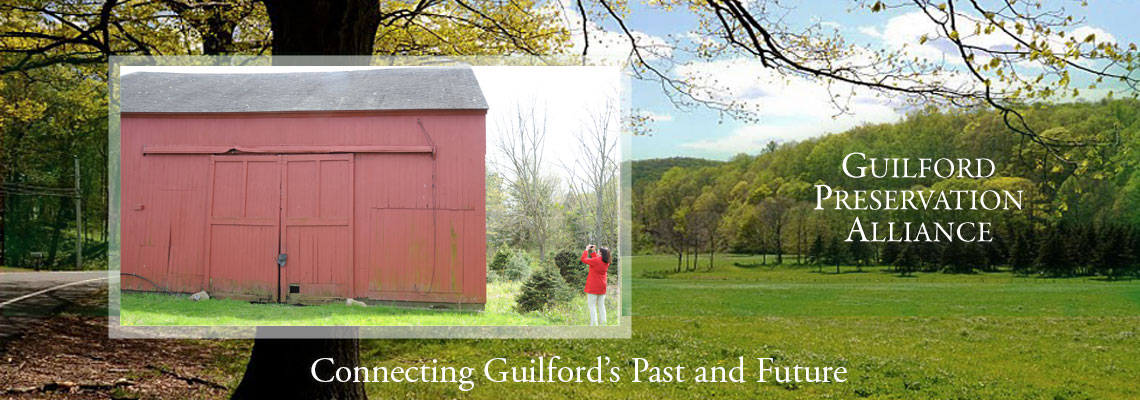
In collaboration with the Connecticut Trust for Historic Preservation, GPA volunteers recently completed a field survey of Guilford’s historic barns and other outbuildings. The statewide survey, including photos and descriptions of many Guilford barns, can be viewed online at www.connecticutbarns.org. The more comprehensive local survey can be consulted in print form in the Historic Room of the Guilford Free Library and will soon be available online at this address. We are also working on plans to expand and improve the GPA’s valuable online survey of historic buildings in Guilford.

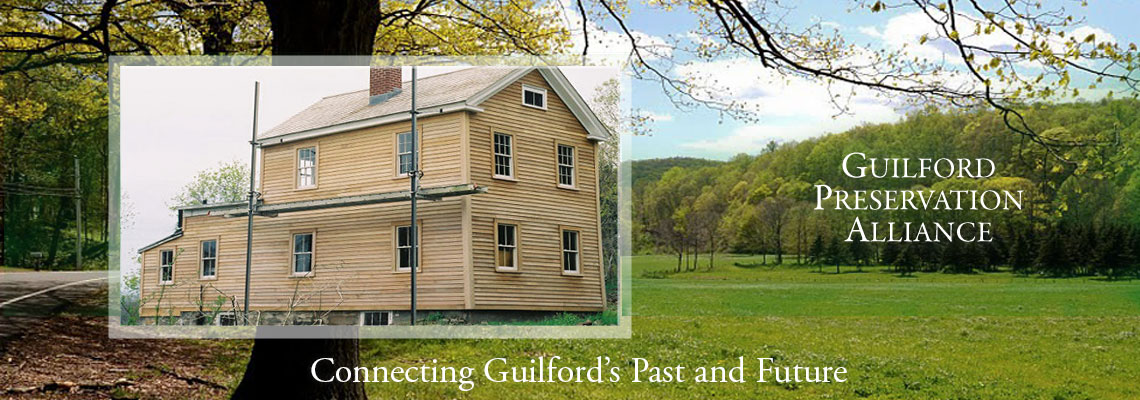
In celebration of our thirtieth anniversary, the GPA will mount an exhibition of Ellen Ebert’s beautiful color photographs of scenic and historic sites around town–this display will appear in the Town Hall sometime in the first half of 2011. A selection of Ellen’s images adorns our new homepage.

For those of you who are not already GPA members, membership is only a click away (see Membership page on our heading above). In filling out our membership form you may also choose to contribute to the Hugh McKay Jones Trust Fund for Historic Preservation. Established in 1985 in honor of Hugh Jones, a noted architect and community benefactor, this revolving fund enables the GPA to provide loans and grants to worthy preservation projects around town. In 2010, for example, we made grants to the Guilford Keeping Society, to help with the upkeep of the Griswold House Museum, and to the Dudley Farm in North Guilford for renovation of a porch roof.

Whatever your particular interest or expertise, the GPA values your input and participation. Remember: your energy, enthusiasm, and ideas are our most important renewable resource!

Best wishes,

Harry Haskell
President

Share

Filed Under: Archive of Posts, View from the Chair Tagged With: Welcome

December 21, 2010 By Web Editor

Dispatches from Dennis

A column about local history by Dennis Culliton, Guilford’s popular middle school teacher.


Guilford as History: A Rich Collection of Mysteries Waiting to Be Answered.

As a child, I walked in the woods and forests of my native Massachusetts and wondered at the stone walls, pens, and foundations of a past civilization that occupied and farmed almost every acre of land east of the Hudson River.  I wondered how the early settlers, the Nipmuck Indians, and the later immigrants made a living in such a rocky habitat.

Twenty years ago, when I first lived in Guilford, and twelve years ago, when my family and I finally settled in Guilford and made it our home, the need to try to understand early settlers and how they made a living again formed inside me.  Why did the Menunkatuck Indians settle here?  Why did the salt box make sense for early residents?  Where did the homeowners who owned such big houses around the Green make such a surplus of income to build such substantial houses?  Who were the indentured servants, slaves, and immigrants who cleaned the stables, made the meals, and emptied the bedpans in those houses?

And Guilford also has signs of a past civilization of farmers, stone cutters, and foundry workers who made the town what it is and were absorbed into the population or relocated to new areas with new opportunities.  In Guilford, we have many areas where the evidence exists to explore the contributions of those who sweated and toiled and drifted away.

Even our Green holds stories yet to be told (or forgotten and yet to be told again.)  How many of the grave stones that were moved from the Green to the West End and Alderbrook were moved without the bodies?  Why is the Civil War monument so prominent in a town that has been sending soldiers to war since the French and Indian War?  Why does it appear that almost ten percent of the names on that same monument are from soldiers who fought and died in African American units in a town that has not had a substantial African American population in its history?

The Civil War monument holds many clues to the stories of the sixty-one men who died to preserve the Union.  These clues can be followed to the Guilford Free Library where letters and diaries from Bentons, Parmelees, and Dudleys sit in cabinets waiting to tell the tales of a soldier’s life and battles from Antietam to Five Forks.  These stories sit beside family records, historic photographs, ancient maps, and the diaries of men and women who thought enough about their lives in Guilford that some amateur historian might someday enjoy reading about how they lived.

There are even more mysteries to explore!  Just Google Fitz-Greene Halleck (the subject of one of the largest statues in Central Park, New York, and of the largest monument in Alderbrook Cemetery) and try to explain why the most popular American poet from the 19th Century is virtually unknown in America (and Guilford) today.

I hope that in future columns I will be able to explain a few of these mysteries; but more importantly, I hope to whet your appetite for all of the interesting morsels of history that are waiting to be uncovered in this special place we call home.  I also hope to introduce you to some of the historic resources and some of the great men and women who keep the stories of Guilford alive for this generation and for generations to come.

Share

Filed Under: Archive of Posts, Dispatches from Dennis Tagged With: Historic Guilford

March 18, 2010 By Web Editor

Guilford Preservation Alliance

Share

https://guilfordpreservation.org/archives/1788/

Filed Under: Home Page Slide Show

March 18, 2010 By Web Editor

Guilford Preservation Alliance

Share

https://guilfordpreservation.org/archives/1785/

Filed Under: Home Page Slide Show

March 18, 2010 By Web Editor

Guilford Preservation Alliance

Share

https://guilfordpreservation.org/archives/1782/

Filed Under: Home Page Slide Show

« Previous Page
Next Page »

Local organizations

  • Dudley Farm Foundation
  • Faulkner's Light Brigade
  • Guilford Agricultural Society
  • Guilford Chamber of Commerce
  • Guilford Free Library Edith B. Nettleton Historical Room
  • Guilford Keeping Society
  • Guilford Land Conservation Trust
  • Henry Whitfield State Museum
  • Historic Guilford
  • Shoreline Greenway Trail
  • The Hyland House Museum
  • Town of Guilford
  • Witness to History: Slavery in Guilford

Tags

A Guilford Minute Awards Civil war Delay of Demolition Heritage tourism Historic buildings Historic Guilford Local Businesses Newsletter parade Quarterly News Sustainable development Train station Trolleys Walking tours Welcome

Archives

Finding Preservation Links

Links to websites of local, regional and national preservation websites, and pertinent government entities, can be found in the sidebar of all subsequent pages beyond the homepage.

Copyright © 2026 Guilford Preservation Alliance · Site by C&DStudios · Log in · [footer_backtotop]