


Archives for 2021
Ship images inside historic Guilford homes
Ship images inside historic Guilford homes
There are several images of ships appearing on the walls of several historic Guilford homes. Some of these homes were owned by those having ties to some type of maritime enterprise or history, and some of these homes were owned by those who were slave owners.
In the attic at 65 Water Street, is a chalk drawing of a ship. That house was originally located on the corner of Whitfield & Boston Streets and moved to 65 Water Street in 1958. That house was built in 1763 for Elias Cadwell, Jr. who was a slave owner, and it is possible that one of his slaves drew that image.
Another house where two ship images were etched into the wood walls leading to the attic is located at 85 Boston Street. This house, known as the Thomas Burgis II house, was built c. 1735/36. Currently, there is no known record that Thomas Burgis II was a slave owner. However, his father, Thomas Burgis was a native of Yorkshire, England, and was compelled to serve for several years aboard a British man-o-war.
It is also possible that the ship graffiti was done by a later owner or occupant.
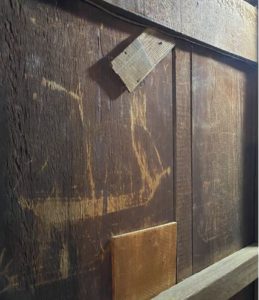
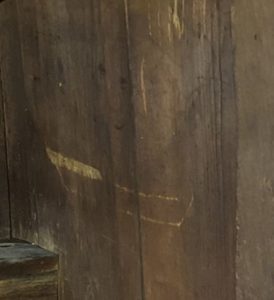
85 Boston Street – Ship 1 (etched) 85 Boston Street – Ship 2 (etched)
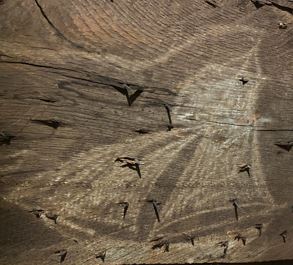
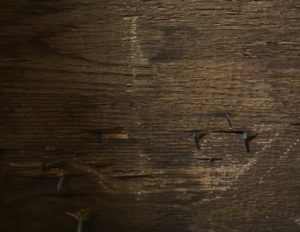
65 Water Street – Ship 1 (chalk) 65 Water Street – Ship 2 (etched)
Photos taken by Tracy Tomaselli (October 2021)
A Guilford Minute: Early Yale College History
At a General Court, held at Guilford, June 28, 1652, it was “voted, the matter about a College at New Haven for us of this jurisdiction to undergo alone; especially considering the unsettled state of New Haven Town; being publicly declared…to be a place of no comfortable subsistence for the present inhabitants there. But if Connecticut do join, the planters are generally willing to bear their just proportions for erecting and maintaining a College there”.
In October 1701, the Legislature, granted a charter, constituting “Trustees of a Collegiate School in his Majesty’s Colony of Connecticut; and invested them with all the powers which were supposed to be necessary for the complete execution of their trust. The following November, they chose one of their number, Mr. Pierson, rector of the school, and determined that it should be fixed for the present at Saybrook”.
“In the year 1702, the first commencement was held at Saybrook, at which five young gentlemen received the degree of A. M. From this time many debates arose concerning the place where the school should finally be established and continued to agitate the community.” October 17, 1716, with the community still disunited, four of the nine trustees strongly voted against moving the school to New Haven. “The trustees, nerveless, proceeded to hold the commencement, the following year, at New Haven, and to order a college to be erected. It was accordingly raised in October 1717 and finished the following year.” The building, enabled through a number of considerable donations, “was built of wood, one hundred and seventy feet long, twenty-two feet wide, and cost about £1000 sterling. Before it was erected, the students were scattered in various places, as Milford, Killingworth, Guilford, Saybrook, Wethersfield, &c. Soon afterwards, they all removed to New Haven. The number of the students was about 40, the course of education was pursued with spirit, the benefactions increased in number and value, from this time the institution began to flourish.”
Connecticut Historical Collections, History and Antiquities of Every Town in Connecticut. John Warner Barber 1836 p. 146
Historic Homes Research Card
The GPA has worked diligently to preserve, and facilitate ways to preserve, the historic character of our community. One piece of this effort includes the newly created Historic Homes Research Card. These cards were composed through the efforts of GPA board member Tracy Tomaselli and Town Historian Joel Helander. If you own an older home in Guilford these cards may be of interest to you!
The purpose of these Historic Homes research cards is to provide education and guidance to homeownership and stewardship, inform property owners and prospective buyers that there may be historical information and resources available, as well as certain restrictions when modifying these homes.
Historic Homes research cards are available at Town Hall South and Town Hall and can be obtained by contacting the GPA at: https://
Praise for the creation of the Historic Homes Research Card from Jordan Sorensen, Development and Special Projects Manager, Preservation Connecticut: “This is such a good idea! I can’t wait to share this with the staff. I think you all have a great model for other local organizations to follow.”